
Getting clicks wasn’t the goal. Getting the right people to take action was.
This local service business needed Google Ads to do more than bring people to the website.
They needed to show up when someone was actively looking for help- and turn that search into an actual call, inquiry, or booked appointment.
Get the before and after numbers and the strategy behind the shift.
By submitting this form you agree to receive the requested case study and occasional marketing emails from LN Marketing Services. You may unsubscribe at any time. View our privacy policy.
Free case study. Unsubscribe at any time.
01 LOCAL SERVICE GOOGLE ADS CASE STUDY
What does it take to turn local Google searches into real customers?
This local service business needed Google Ads to do more than bring people to the website.
They needed to show up when someone was actively looking for their service — and turn that search into an actual inquiry or booked appointment.
In this case study, I break down what we changed, what the data started showing us, and how the campaigns generated real high-intent actions across multiple locations.
Inside, you’ll see:
how Google Ads captured people already searching for this service
what I looked at beyond clicks and traffic
how calls and booked appointments helped show which traffic was actually valuable
what performance across multiple locations revealed about local demand
what the results told me about where the budget was actually doing its job
See the numbers, what I was watching, and what the customer path actually showed.
02 ABOUT THE STRATEGY

I don’t just manage the ads.
I look at what is actually ready to scale.
I’m Lauren Nebel, a paid growth strategist and Google Ads specialist. I help established businesses understand what is actually happening between their ads, website, tracking, offer, and customer path so they can make smarter decisions before spending more money trying to scale.
I learned paid ads through my own ecommerce business, so I know the pressure behind the numbers. Ad spend is not just another metric on a dashboard. It is real money tied to real business decisions.
That is why I use my Proof Before Scale Framework when I evaluate paid growth. It helps me look beyond campaign activity and understand whether the business has the signals, structure, and customer movement needed to support the next stage of growth.
Sometimes the opportunity is in the campaign. Other times, the real gap is the offer, landing page, tracking, product mix, or the path customers take after the click.
The goal is to find the next smartest move and scale what already has proof.
The Proof Before Scale Framework
A strategic way of evaluating the full paid-growth path before increasing budget or expanding campaigns.
It looks at whether the ads, offer, website, tracking, and customer behavior are giving us enough evidence to scale with more confidence.
Find the proof. Identify the gap. Scale what’s ready.
03 THE SIGNALS
The clicks were only the first signal.
Getting someone to the website told me the ads were creating interest.
But for a local service business, that wasn’t enough.
I wanted to know what happened next.
Were people calling?
Were those calls turning into booked appointments?
Were certain locations producing stronger results than others?
And was the cost to generate those actions actually making sense for the business?
That’s where the campaign started telling us a much more useful story.
110+
Phone Call Leads Generated
30
Booked Appointments in
Dublin/Columbus in Oct.
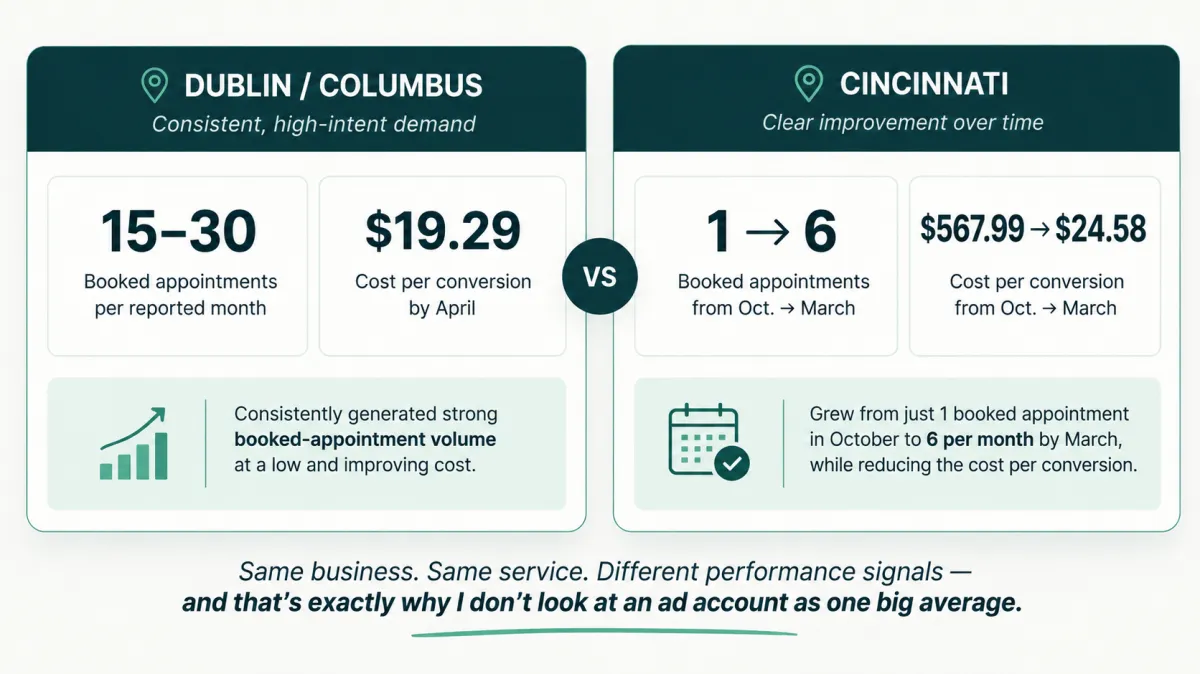
$19.29
Cost per conversion in Dublin/Columbus by April
1 → 6
Cincinnati booked appointments grew from 1-6 /month
Under $1K
Total monthly campaign cost including management
The numbers mattered, but what they showed about local demand and customer behavior was even more useful.
The real value wasn’t just the lead volume. It was seeing where the strongest customer intent was actually coming from.
04 BEHIND THE RESULT
The locations weren’t performing the same- and that mattered.
Dublin/Columbus was consistently generating booked appointments at a relatively low cost.
Cincinnati started very differently, with just 1 booked appointment in October at a $567.99 cost per conversion.
By March, that had grown to 6 booked appointments at $24.58 each.
The goal wasn’t to make every location perform identically. It was to understand what the data was telling us and make better decisions from there.
What the data revealed
Lead volume alone wasn’t enough to judge performance. We also looked at what happened between the ad click and the final inquiry or booked call.
Prospects were moving through service pages, featured work, and other supporting content before converting- giving us a clearer picture of where intent was building.
See the complete strategy, campaign decisions, and results.
05 GET THE CASE STUDY
See the Google Ads strategy behind the numbers.
Get the full breakdown of what changed, what the campaign data revealed, and how those decisions translated into more booked appointments across multiple locations.
Inside, I break down:
what the account looked like before the strategy shifted
how performance differed across locations
what the booked-appointment data showed beyond lead volume
how one location went from 1 to 6 booked appointments per month
how cost per conversion dropped as the campaign improved
what the customer path showed us about how people converted
The interesting part wasn't just that Google Ads generated leads.
It was seeing how differently each location performed, and using those signals to make better decisions about where the budget was actually working.