
A small Meta Ads budget left little room for guessing.
This local home service business needed Meta Ads to consistently generate leads without relying on a large advertising budget.
So I tested the audiences, messaging, creative, and campaign settings to find what was actually earning a response and what wasn't.
Get the campaign results and the strategy behind the testing.
By submitting this form you agree to receive the requested case study and occasional marketing emails from LN Marketing Services. You may unsubscribe at any time. View our privacy policy.
Free case study. Unsubscribe at any time.
01 LOCAL HOME SERVICES META ADS CASE STUDY
What does it take to make a limited Meta Ads budget actually work?
This local home service business needed Meta Ads to generate a steady flow of leads without a massive advertising budget.
That meant every campaign decision mattered- from the audience and creative to the offer, messaging, placements, and how the budget was distributed.
In this case study, I break down what I tested, what the performance data revealed, and how I used those signals to make better decisions instead of simply spending more.
Inside, you’ll see:
how the Meta campaigns were structured and tested
which audiences, messages, and creatives generated a responsehow calls and booked appointments helped show which traffic was actually valuable
how I evaluated performance beyond clicks and engagement
what the lead data revealed about where the budget was working
how the campaign evolved based on actual performance signals
See the numbers, what I was watching, and what the customer path actually showed.
02 ABOUT THE STRATEGY

I don’t just manage the ads.
I look at what is actually ready to scale.
I’m Lauren Nebel, a paid growth strategist and Google Ads specialist. I help established businesses understand what is actually happening between their ads, website, tracking, offer, and customer path so they can make smarter decisions before spending more money trying to scale.
I learned paid ads through my own ecommerce business, so I know the pressure behind the numbers. Ad spend is not just another metric on a dashboard. It is real money tied to real business decisions.
That is why I use my Proof Before Scale Framework when I evaluate paid growth. It helps me look beyond campaign activity and understand whether the business has the signals, structure, and customer movement needed to support the next stage of growth.
Sometimes the opportunity is in the campaign. Other times, the real gap is the offer, landing page, tracking, product mix, or the path customers take after the click.
The goal is to find the next smartest move and scale what already has proof.
The Proof Before Scale Framework
A strategic way of evaluating the full paid-growth path before increasing budget or expanding campaigns.
It looks at whether the ads, offer, website, tracking, and customer behavior are giving us enough evidence to scale with more confidence.
Find the proof. Identify the gap. Scale what’s ready.
03 THE SIGNALS
The clicks were only the first signal.
Meta was generating traffic, but I needed to know which changes were actually producing leads — and which ones were just creating activity.
I wanted to know what was actually moving the account forward.
Which messages were connecting?
Which audiences were producing leads?
Were creative changes improving performance?
Were Meta’s recommended settings helping — or making the account more expensive?
And what happened when the platform didn’t capture the entire customer journey?
That’s where the campaign started giving us much more useful signals.
40
Platform conversions*
$22.25
Best Documented Weekly Cost per Conversion
6
Conversions in the Strongest Documented Reporting Period
5.75%
CTR Reached in a Standard Weekly Reporting Period
4 phone calls
Captured in One Week When No Standard Meta Lead Was Recorded
*Across reporting periods where conversion data was available. Results are based on historical platform reporting and do not represent closed-job or revenue totals.
The real value wasn’t just the lead volume. It was seeing where the strongest customer intent was actually coming from.
04 BEHIND THE RESULT
The account improved because the strategy kept changing with the data.
The account didn’t improve because of one winning ad.
It improved because the testing became more intentional.
When CTR dropped, I refreshed the messaging and creative.
When one ad started connecting better, I used that message pattern to improve the weaker ads.
When a Meta-recommended setting increased impressions but hurt clicks and lead cost, I reversed it.
And when a more manual campaign structure started producing stronger traffic and lower acquisition costs, I kept building from there.
The goal wasn’t to chase every fluctuation. It was to understand what the account was teaching us and make the next decision from that.
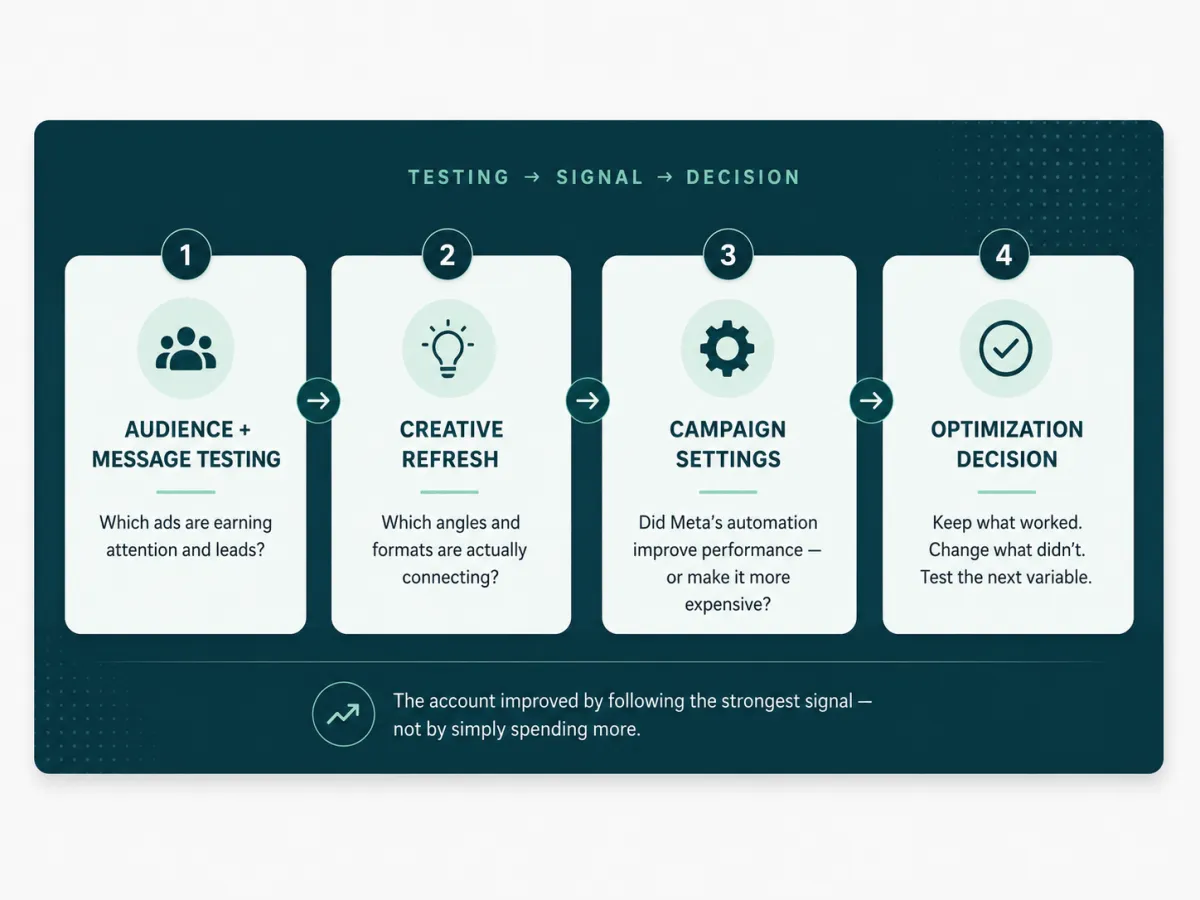
What the data revealed
The account improved by following the strongest signal. Not by simply spending more.
See the complete strategy, campaign decisions, and results.
05 GET THE CASE STUDY
See the Meta Ads strategy behind the results.
Get the full breakdown of what I tested, what the campaign data revealed, and how those signals shaped the next optimization decisions.
Inside, I break down:
what the account looked like before the strategy evolved
how audience and messaging tests influenced the next campaign decisions
which performance signals mattered beyond clicks and engagement
how stronger ad messaging was carried into weaker-performing ads
what happened when a Meta-recommended setting hurt efficiency
why I shifted back toward a more manual campaign structure
The interesting part wasn’t just that Meta Ads generated leads.
It was seeing how audience, message, creative, and campaign settings worked together and using those signals to decide what deserved the next dollar.