Our Blogs
I’m passionate about exploring the ins and outs of Google Ads and ad optimization strategies to share insights that can make a difference. Helping smaller businesses succeed is something I truly care about, and I love offering practical tips and advice whenever I can. My goal is to provide content that’s both helpful and easy to understand, so businesses of all sizes can see real results.

Read Our Newest Posts!
Fix the Leak Before Scaling
Fix the Leak Before Scaling
Why More Traffic Won’t Fix a Broken Conversion Path
When marketing performance slows down, the most common reaction is simple: increase traffic. Businesses assume that if they can just get more people to the website, conversions will follow. The logic feels straightforward. More ads lead to more clicks, and more clicks should lead to more customers.
But more traffic does not fix a broken funnel. It simply sends more people into the leak.
A common example illustrates this clearly. Imagine a website that converts at 1%. If one hundred people visit the site, one person becomes a customer. The natural assumption is that doubling traffic will double results. If two hundred people visit the site, then two customers should convert. Technically, that is true. But something else also doubled: the number of people who clicked and did not convert. Instead of ninety-nine missed opportunities, there are now one hundred ninety-eight. When the conversion path is weak, scaling traffic simply magnifies the inefficiency.
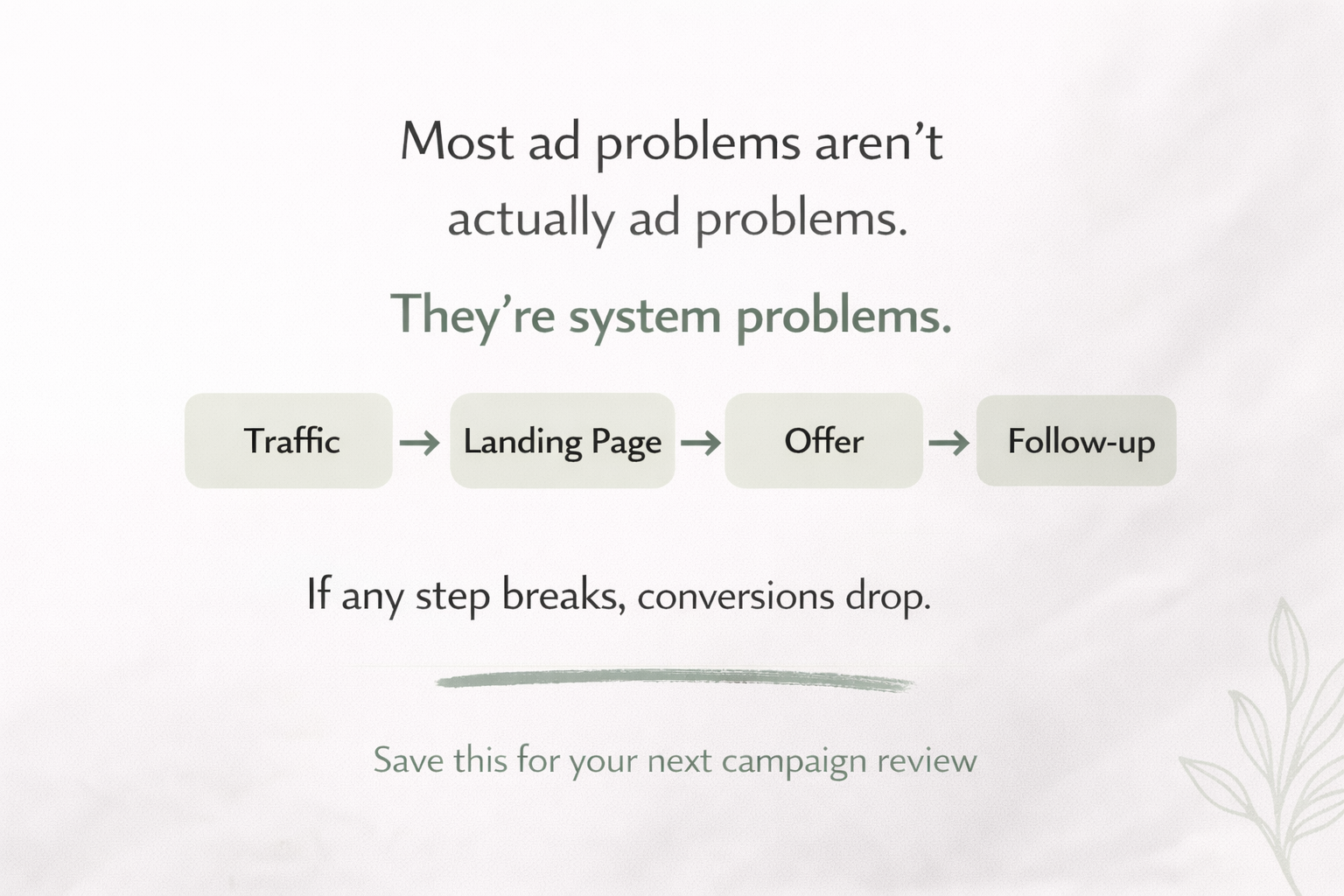
This is where many businesses accidentally focus on the wrong part of the system. Ads only control one thing: getting the click. Once someone clicks an ad, the responsibility shifts away from the advertising platform and into the funnel itself. The visitor now experiences the landing page, evaluates the offer, and decides whether to take the next step. If any part of that path is confusing, unclear, or disconnected, the conversion rate drops quickly.
In most cases, the issue is not that the ads are failing. The issue is that the system after the click has friction built into it. Visitors arrive with interest, but something in the experience causes them to leave before converting.
Before increasing ad spend, I always step back and examine the conversion path more closely. The first thing I look at is landing page clarity. When someone lands on the page, they should immediately understand what the offer is, who it is for, and what action they should take next. If a visitor has to search for the value proposition or figure out what the business actually provides, most will leave within seconds.
The second factor is the strength of the offer itself. Even well-targeted traffic cannot convert if the offer does not feel compelling. A strong offer makes the value obvious and answers the question every visitor is asking: why should I choose this now instead of later or somewhere else?
Tracking accuracy is another critical piece. Sometimes campaigns appear to perform poorly simply because the measurement system is incomplete. If conversion tracking is broken or analytics platforms are misaligned, businesses can make decisions based on incorrect data. Before diagnosing performance issues, it is essential to confirm that the numbers being used are actually reliable.
Finally, I look at the follow-up system. Not every visitor converts on their first visit. In fact, many people need time to evaluate options before making a decision. Without remarketing, email sequences, or other forms of follow-up, many potential customers simply disappear after the initial click. A strong follow-up system often recovers conversions that would otherwise be lost.
When these pieces are working together, scaling advertising can become a powerful growth lever. More traffic then leads to more customers because the system is designed to convert visitors effectively. But when the funnel is leaking, increasing traffic only increases wasted spend.
Scaling should never be the first step. It should be the result of a funnel that is already functioning well.
Scale what works. Fix what doesn’t.
Because more traffic does not fix a broken funnel. It only sends more people into the leak.
Want to Know If Your Funnel Is Ready for Traffic?
Before increasing ad spend, it’s important to make sure the system behind your marketing is actually built to convert.
I created a simple checklist that walks through the key things I review before scaling campaigns.
Landing page clarity.
Offer strength.
Tracking accuracy.
Follow-up systems.
You can grab the checklist here: checklist.laurennebel.com
It’s a quick way to spot the leaks before sending more traffic into your funnel.

Book a Call With One of Our Agents Today

Blending Growth with innovation.
Navigation
Contact Us
Call Or Text: (916) 318-0373


© 2022 LN Marketing Services. All Rights Reserved