B2B SAAS CASE STUDY
How an educational funnel helped turn cold traffic into qualified demo bookings
The product had strong value and the company could close the right prospects once they reached the calendar.
The challenge was getting cold traffic ready to take that step.
Instead of forcing every prospect directly into a demo request, the funnel used education to create a lower-friction path toward the sales conversation.
CLIENT
Niche B2B SaaS company
PLATFORMS
Meta Ads and Google Ads
FOCUS
Audience education, lead magnet funnel, and qualified demo bookings
FREE B2B SAAS CASE STUDY
The demo was not the first conversion.
See how an educational lead magnet created a more natural path from cold traffic to qualified sales conversations.
The full case study breaks down how the funnel supported prospects before they were ready to book, how Meta and Google played different roles, and how the campaign contributed to new recurring revenue.
Inside the case study:
why cold traffic needed education before a demo request
how the lead magnet lowered the initial commitment
how Meta created and educated demand
how Google captured higher-intent searches
how the funnel contributed to demo bookings and new customers
01 THE CHALLENGE
The offer was strong. Cold traffic was not ready for the demo yet.
The company needed more qualified demo bookings from a highly specific niche audience.
The product had strong value, and the client reported a strong close rate once the right prospects reached the calendar.
The issue was getting cold prospects to take that first step.
For someone still trying to understand the problem, compare systems, or decide whether switching software was necessary, an immediate demo request could feel like too much commitment.
The audience needed more context first.
They needed to understand what problems to look for, what questions to ask, and how the right software could support the business as it grew.
THE REAL GOAL
The goal was not to flood the funnel with low-quality leads.
It was to help fewer, better-fit prospects understand the problem, build trust, and become ready for a sales conversation.
Highly specific
Niche B2B audience
High commitment
Direct demo request
Strong close rate
Once the right prospects booked
Education first
Lower-friction entry point
02 THE STRATEGY
The strategy matched the next step to the prospect’s level of readiness.
The campaign did not treat every visitor as though they were equally ready to speak with sales.
Instead, it created a path for earlier-stage prospects to learn first while still capturing people who were already actively searching for a solution.
01
Created a lower-friction entry point
The lead magnet gave cold prospects a useful first step without requiring an immediate sales commitment.
02
Built understanding before the demo
The resource helped prospects identify problems, evaluate software options, and understand what to ask before speaking with vendors.
03
Used Meta to educate demand
Meta Ads introduced the resource to a niche audience that may have recognized the problem but was not ready to book yet.
04
Used Google to capture demand
Google Ads supported prospects who were actively searching and closer to taking a higher-intent action.
03 THE RESULTS
A smaller educational funnel created meaningful sales movement.
The strongest result was not a massive volume of form submissions.
It was that the funnel helped move prospects from education into higher-intent sales activity and new recurring revenue.
10
Ebook-download events
Recorded in GA4 during March 2026.
9
Booked-demo events
Recorded in GA4 during the same reporting period.
2
New customers
Reported by the client after the booked demos.
$460
Approximate new monthly recurring revenue
Based on an estimated subscription value of around $230 per customer per month.
The educational step did more than collect emails. It helped move cold prospects toward demo bookings and new customers.
With two new customers representing approximately $460 in combined monthly recurring revenue, the funnel created ongoing business value beyond the initial download.
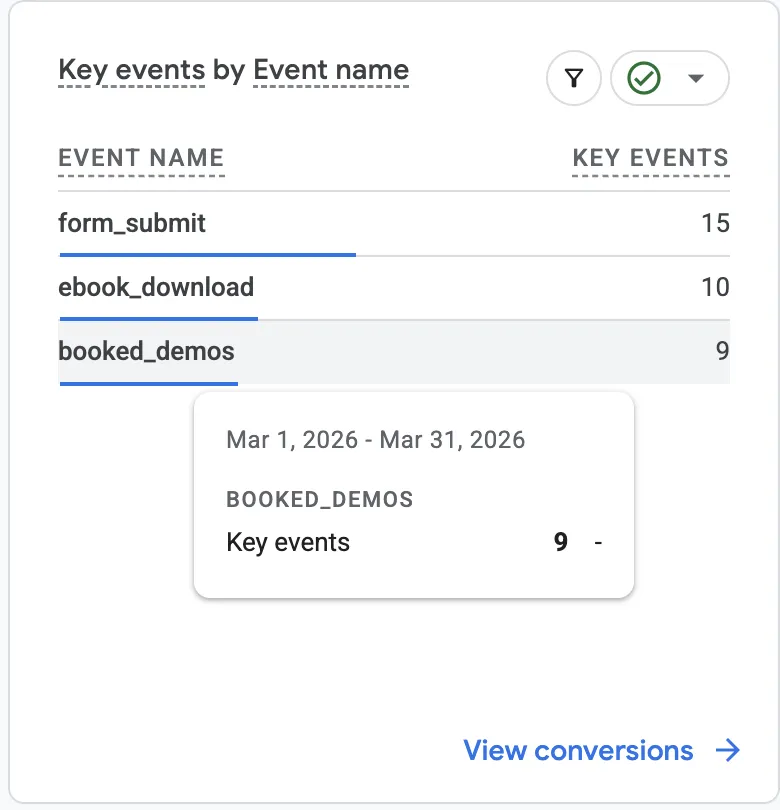
GA4 funnel activity for March 1–31, 2026.
What the numbers showed
The lead magnet was not functioning as a disconnected top-of-funnel asset.
Prospects were continuing from the educational step into higher-intent demo activity.
That gave the campaign a clearer signal that the funnel was helping people move forward rather than simply collecting email addresses.
GA4 totals reflect tracked ebook-download and booked-demo events and may not represent unique individuals. New-customer outcomes were reported by the client. Monthly recurring revenue is based on the approximate subscription value at the time. Results from one anonymized engagement are not a guarantee of future performance.
04 BEHIND THE RESULT
The funnel worked because it did not ask cold traffic to decide too early.
A demo is often not the first meaningful conversion in B2B SaaS.
It can be the result of several smaller steps that help the prospect understand the problem, trust the company, and feel ready to enter a sales conversation.
The educational lead magnet created that bridge.
Ad→
Lead magnet→
Education→
Trust→
Demo booking→
Sales opportunity
What changed in the customer path
Instead of sending every visitor directly toward a demo, the funnel gave earlier-stage prospects a useful way to engage first.
They could learn, evaluate their current situation, and better understand what they needed before speaking with sales.
Why this mattered
A demo asks for time, attention, and commitment.
The lead magnet lowered that first barrier while still keeping the product and the next step connected to the problem the prospect was trying to solve.
01
Matched the commitment level
The first ask reflected how ready the prospect actually was.
02
Let intent develop
The funnel supported people who were interested but not yet sales-ready.
03
Measured movement, not only downloads
The stronger signal was whether prospects continued from education into demos and customers.
The campaign worked because it gave the right prospects enough context before asking them to book.
The goal was not to force more people into a demo. It was to help the right people become ready for one.
05 WHAT CHANGED
Education became part of the acquisition strategy—not just a lead-generation tactic.
The lead magnet was not treated as a disconnected download.
Its role was to help prospects move from early interest toward a more informed and qualified sales conversation.
The campaign started looking beyond the first conversion and paying closer attention to whether people continued moving through the funnel.
BEFORE
The demo carried too much weight:
Cold visitors were expected to take a high-commitment action.
Earlier-stage interest had nowhere useful to go.
Prospects who needed more context could leave before becoming sales-ready.
Lead volume alone could not explain whether the audience was moving closer to a decision.
AFTER
The funnel supported readiness:
Prospects could take a lower-friction first step.
Education answered questions before the sales conversation.
Meta and Google supported different levels of buyer intent.
Success was connected to movement from downloads into demos and new customers.
The campaign moved from asking, “How do we get more demo requests?” to asking, “What does the right prospect need before they are ready to book?”
That made the lead magnet part of the paid acquisition system—not simply a way to collect more email addresses.
06 THE BIGGER LESSON
A demo is often not the first conversion.
For B2B SaaS companies, the sales conversation may be the result of a stronger education path not the first step in it.
A strategically built lead magnet can do more than collect email addresses.
It can help prospects:
recognize the problem
understand what to evaluate
build trust in the company
become more prepared for a high-intent sales conversation
The campaign worked because it did not force cold traffic into a decision too early.
It gave the right prospects enough context before asking them to book.
The strongest funnel does not always push for the biggest conversion first.
It gives the right prospect the next step they are actually ready to take.
GET THE FULL CASE STUDY
See how education became the bridge between a cold click and a qualified demo.
Download the complete case study to see how the funnel was structured, why the lead magnet came before the demo request, and how Meta Ads and Google Ads supported prospects at different stages of intent.
You’ll also see how the campaign moved from educational engagement into booked demos, new customers, and recurring revenue.
Not ready to download another resource?
The bigger issue may be that your campaign, landing page, and customer path are not giving you a clear read on what is actually driving sales conversations.
That is the kind of work I look at inside Active Ads Management.

80%
As of December 2023,
80% of global businesses use Google Ads for their Pay-per-Click (PPC) campaigns.

65%
of small to mid-sized businesses also use PPC campaigns.

In 2022
Google's ad revenue in the U.S. was $224.47 billion
Built for businesses that already have something working
The best fit clients are not starting from zero. They already have demand, customers, or existing ad activity but need a clearer view of what is driving growth and where the customer path may be leaking.
A strong fit
Your business is already generating leads or sales
You are actively investing in Google or Meta ads
You have enough budget and room to test
You are open to improving landing pages, messaging, and tracking
You want strategy tied to real business outcomes
Probably not the right fit yet
You are relying on ads to prove an untested offer
You want campaign execution without looking at the wider customer path.
You cannot make changes outside the campaigns
Your budget does not leave enough room to test and learn.
Success is defined only as more traffic or cheaper clicks
FREE RESOURCES
Want a free Marketing Audit? Head to our Resources page and fill out a survey .

Blending Growth with innovation.
Navigation
Contact Us
Call Or Text: (916) 318-0373


© 2026 LN Marketing Services. All Rights Reserved