META ADS CASE STUDY
How one brand studio reduced wasted lead volume and closed more ideal clients
The account did not need the highest possible number of leads.
It needed a more efficient path to prospects who were financially aligned, ready for the offer, and more likely to become real clients.
CLIENT
Brand Strategy and design studio
PLATFORM
Meta Ads
FOCUS
Lead quality, booked call efficiency, landing-page testing, and customer path tracking
FREE CAMPAIGN LEVEL CASE STUDY
The better result did not come from generating more leads.
See how one brand studio reduced ad spend, improved booked-call quality, and closed three ideal clients worth around $10,000 each.
Inside the free case study:
What the account looked like before
How spend was reduced
Why fewer, better-fit calls created a stronger result
What the customer path revealed
How business outcomes changed the next decisions
01 THE CHALLENGE
The account was generating leads. Too many of them were not the right fit.
Before the strategy changed, the studio spent $907.13 during April 2026 and generated 17 Meta-reported leads and seven Meta-reported appointments.
The campaign was creating activity, but many of those leads were not financially aligned with the studio’s premium brand and website services.
The business was still closing approximately one to two ideal clients, which told me there was already proof in the system.
The problem was not that Meta Ads could not generate business.
Too much of the spend was supporting lower-quality lead volume around the opportunities that actually mattered.
For a premium service business, more leads do not automatically mean stronger growth.
An ideal client for this studio is worth around $10,000 USD.
THE REAL GOAL
The goal was not to generate more leads.
It was to reduce weaker-fit volume while creating a cleaner path to the prospects who could become ideal clients.
$907.13
Meta spend
17
Reported leads
7
Reported appointments
1-2
Ideal clients closed
02 THE STRATEGY
The strategy shifted from lead volume to business value.
The account already had proof that Meta Ads could contribute to client acquisition.
So I did not treat it like a broken campaign that needed to be rebuilt from zero.
The next move was to understand what was helping the right prospects move forward, reduce the spend supporting weaker-fit leads, and measure success closer to the actual business outcome.
01
Protected what was already working
The business was already closing ideal clients from Meta Ads, so the strategy built from that proof instead of starting over.
02
Reduced spend behind weaker-fit volume
Budget decisions focused less on producing the highest lead count and more on reducing lower-quality activity.
03
Looked beyond Meta’s lead count
Booked calls, client fit, and closed-client outcomes became more important than total form submissions.
04
Mapped the customer path
The campaign looked at the pages and steps stronger prospects moved through before they were ready to book.
03 THE RESULTS
The result was a more efficient path to more ideal-client closes.
The reporting periods below are similar in length and show how the quality of the sales opportunities changed alongside the ad spend.
BEFORE
April 1–30, 2026
$907.13
Meta ad spend
17
Meta-reported leads
7
Meta-reported appointments
1–2
Approximate ideal clients closed
AFTER
June 14–July 14, 2026
$782.34
Meta ad spend
5 out of 5
Booked calls matched the ideal-client profile
3
Ideal clients closed
$260.78
Approximate ad spend per ideal client acquired
The studio spent less, worked through fewer booked calls, and closed three ideal clients because the prospects entering the sales process were better aligned from the start.
With an ideal client value of approximately $10,000 USD, those three clients represented approximately $30,000 in potential project value from $782.34 in Meta ad spend.
Meta-reported lead and appointment totals are platform metrics. Booked-call quality and closed-client outcomes were verified through client feedback. Results shown are from one anonymized client engagement and are not a guarantee of future performance.
04 BEHIND THE RESULT
The campaign did not need more lead volume. It needed less waste around the leads that mattered.
The business was already closing ideal clients from Meta Ads.
That told me there was proof in the system.
So the goal was not to rebuild everything from zero. It was to understand what was helping stronger prospects move forward, reduce the spend behind weaker-fit leads, and make the customer path more efficient.
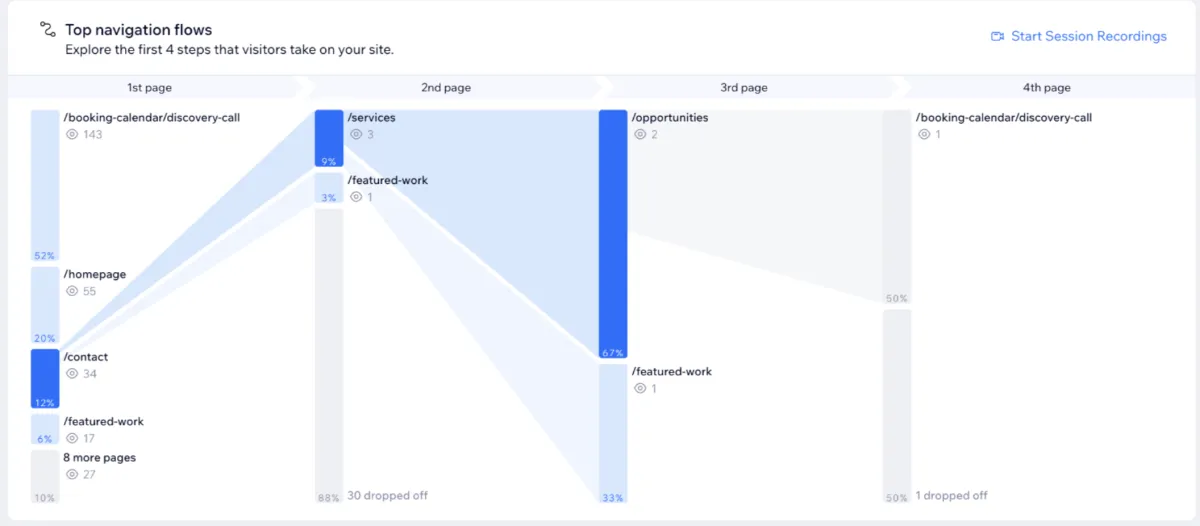
Customer-path data showed that stronger prospects often explored supporting pages before booking.
What the customer path revealed
Stronger prospects were not always ready to move directly from the first page into a booked call.
The navigation flow showed that visitors also moved through the studio’s Services, Featured Work, and other supporting pages before taking the next step.
Those pages helped prospects understand the offer, build trust, and decide whether the studio was the right fit.
Why this mattered
The account could not be judged by total lead volume alone.
The stronger signal was whether the right prospects had enough context to book and whether the business could protect those opportunities while spending less.
01
Tracked the path before the conversion
We looked at what happened between the ad click and the final inquiry or booked call.
02
Tested the level of commitment
The campaign compared a direct book-a-call path against a lower-friction inquiry path.
03
Used business value to guide the next move
The next decision was based on which path created stronger-fit opportunities—not simply the highest number of submissions.
05 WHAT CHANGED
The campaign started measuring the outcome the business actually cared about.
Before, the account could look successful because it was generating leads and appointments.
But those platform numbers did not explain whether the right prospects were entering the sales process—or whether those opportunities were becoming valuable clients.
Before: activity was the main signal
The account was being judged largely by:
total leads
total appointments
cost per lead
form submissions
Those numbers showed activity, but they did not show:
which prospects were financially aligned
which calls matched the ideal-client profile
which opportunities were worth the owner’s time
which prospects became clients
After: business value became the stronger signal
The account was evaluated against:
booked discovery calls
whether those calls matched the ideal-client profile
whether the prospect could realistically afford the offer
whether the opportunity became a client
how much ad spend supported each ideal-client acquisition
The goal was no longer to create the largest possible number of leads.
It was to create better sales opportunities from a more efficient level of spend.
The account moved from optimizing for activity to optimizing for business value.
That shift made it easier to see which parts of the campaign were actually helping the studio grow and which parts were only making the dashboard look busy.a Paragraph Font
06 THE BIGGER LESSON
Fewer booked calls can create a stronger result.
The after period produced fewer booked calls than the before period.
But all five booked calls matched the studio’s ideal-client profile, and three became clients.
That is the part a basic ad dashboard does not explain.
A campaign can generate more leads and still create more work, more unqualified conversations, and less value for the business.
For a premium service business, one strong-fit client can be worth more than several weaker-fit leads combined.
The better question is not always:
“How do we generate more leads?”
Sometimes it is:
“How do we protect the opportunities we want while spending less on the ones we do not?”
Less spend. Better-fit booked calls. More ideal clients closed.
$782.34
Meta ad spend
5 out of 5
Booked calls matched the ideal-client profile
3
Ideal clients closed
With each ideal client worth around $10,000 USD, the campaign created a stronger potential return by improving the quality of the sales opportunities—not by chasing the largest possible lead count.
READY FOR A CLEARER READ ON YOUR LEADS?
Your campaign may not need more leads. It may need a better way to identify which ones are actually helping the business grow.
I look beyond the ad dashboard and connect the campaign to the landing pages, tracking, customer path, booked calls, lead quality, and verified business outcomes.
The goal is to understand what is working, what is leaking, and where the budget can be used more efficiently before more money goes behind it.

80%
As of December 2023,
80% of global businesses use Google Ads for their Pay-per-Click (PPC) campaigns.

65%
of small to mid-sized businesses also use PPC campaigns.

In 2022
Google's ad revenue in the U.S. was $224.47 billion
Built for businesses that already have something working
The best fit clients are not starting from zero. They already have demand, customers, or existing ad activity but need a clearer view of what is driving growth and where the customer path may be leaking.
A strong fit
Your business is already generating leads or sales
You are actively investing in Google or Meta ads
You have enough budget and room to test
You are open to improving landing pages, messaging, and tracking
You want strategy tied to real business outcomes
Probably not the right fit yet
You are relying on ads to prove an untested offer
You want campaign execution without looking at the wider customer path.
You cannot make changes outside the campaigns
Your budget does not leave enough room to test and learn.
Success is defined only as more traffic or cheaper clicks

Blending Growth with innovation.
Navigation
Contact Us
Call Or Text: (916) 318-0373


© 2026 LN Marketing Services. All Rights Reserved