ECOMMERCE GOOGLE ADS CASE STUDY
How one regulated ecommerce brand moved beyond a 3x ROAS ceiling
The breakthrough did not come from launching one lucky Performance Max campaign. It came from building stronger purchase signals, learning from earlier campaigns, and putting more budget behind the products already showing real buyer demand.
Client
Australian regulated beverage e-commerce retailer
Platform
Google Ads
Focus
Performance Max, Search, Shopping, and conversion-signal development
FREE CAMPAIGN-LEVEL CASE STUDY
The strongest campaign wasn’t the first campaign.
See how earlier campaign learning, real product demand, and stronger purchase signals supported A$45,202 in tracked ecommerce revenue from A$2,878 in Google Ads spend.
Inside the free case study:
Why Performance Max was not the first move
How earlier campaigns strengthened the purchase signals
How product performance guided where the budget went
Why the result depended on more than choosing the “right” campaign type
Free case study. No spam. Unsubscribe at any time.
01 THE CHALLENGE
The account had activity. It did not yet have enough proof to scale confidently.
The performance ceiling
The retailer had strong products and real customer demand, but the Google Ads account was struggling to consistently move beyond a 3x ROAS.
The account was generating purchases, but the return was not yet reliable enough to confidently increase budget. More campaigns and more activity would not automatically solve the underlying problem.
A tightly controlled advertising category
The client also operated in a policy-restricted category. Campaign approvals, asset eligibility, targeting, and the ability to scale could all be affected by advertising policies.
The strategy needed to work within those restrictions while also building stronger conversion data and clearer purchase signals.
What the account actually needed:
Stronger purchase signals
Clearer product-level performance data
More reliable conversion volume
A structure informed by earlier campaign learning
A customer path that supported the traffic
The account did not need more activity. It needed stronger evidence.
02 THE STRATEGY
The next move was based on what the account had already proven.
Performance Max was not treated like a reset button. Earlier campaign data, product-level performance, purchase behavior, and the customer path were used to guide what happened next.
01
Built on earlier learning
Previous campaigns showed what the account needed before it was ready to scale. Instead of discarding that history, the learning became part of the next campaign build.
02
Followed real product demand
Product-level performance revealed where buyer intent was already strongest, helping guide which products received more budget and visibility.
03
Connected spend to buyer movement
Budget decisions were guided by purchases, customer behavior, and tracked revenue—not clicks or campaign activity alone.
Proof Before Scale Framework: Find the proof. Identify the gap. Scale what is ready.
03 THE RESULTS
The result was more than account activity. It was real buyer movement.
Results below reflect the broader account performance documented during the case-study period.
90.32%
Increase in tracked revenue
84.39%
Increase in tracked purchases
A$216,328
Tracked account revenue
1,236+
Tracked website purchases
556+
New customers
The strongest Performance Max campaign
12.03x
Tracked ROAS
The strongest campaign was not the first campaign built for the account. It benefited from the conversion signals, product-level learning, and purchase history created by the campaigns that came before it.
Results shown are from one anonymized client engagement and are not a guarantee of future performance.
04 THE CAMPAIGN PROGRESSION
The later campaign performed better because it had stronger signals to build from.
This was not a matter of simply choosing a different campaign type. Earlier campaigns helped reveal product demand, build purchase history, and give Google clearer information about the customers most likely to buy.
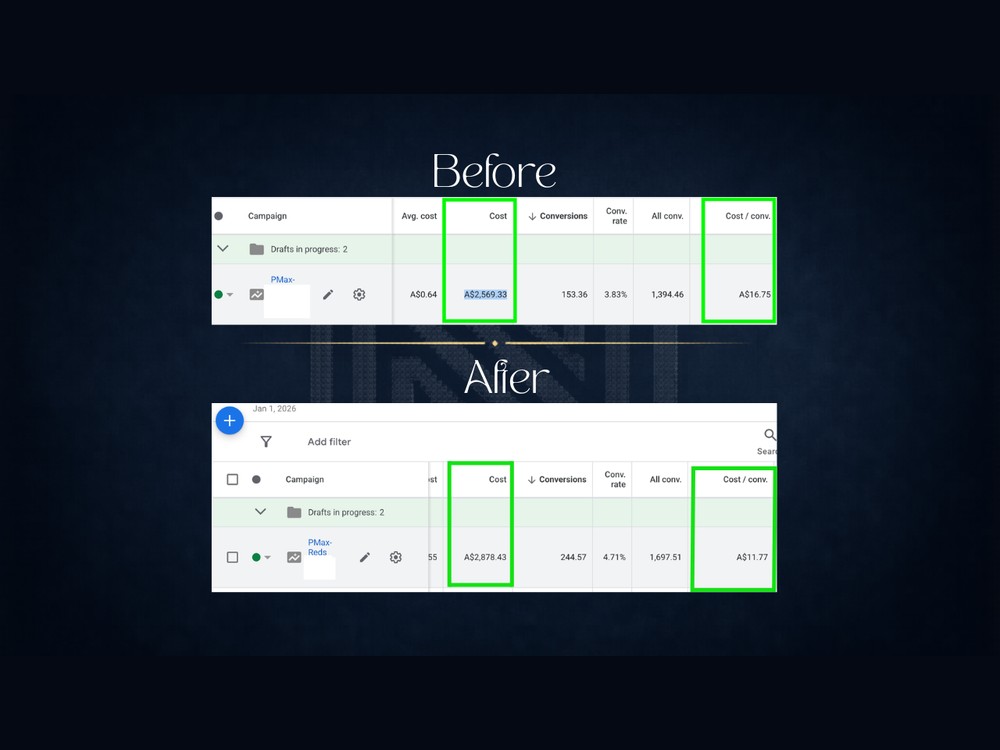
What changed between the campaigns
Earlier Campaign
A$2,569 in spend
153 tracked conversions
3.83% conversion rate
A$16.75 cost per conversion
Later campaign
A$2,878 in spend
244 tracked conversions
4.71% conversion rate
A$11.77 cost per conversion
Spend increased by about 12%, while tracked conversions increased by nearly 60% and cost per conversion decreased by almost 30%.
The improvement came from what the account had learned—not from treating the later campaign as a fresh start.
05 WHAT THIS MEANS
Performance Max was not the strategy. It was the next logical move.
The account did not improve because one campaign type suddenly fixed everything. Performance Max became more effective once the business had stronger conversion signals, clearer product-level demand, and enough purchase history for Google to make better decisions.
That is the distinction behind my Proof Before Scale Framework. Before increasing budget or expanding campaigns, I look at what the business has already proven, where the customer path is still leaking, and what is genuinely ready to scale.
Find the proof. Identify the gap. Scale what is ready.
Sometimes the opportunity is inside the campaign. Other times, the real constraint is the offer, tracking, landing page, product mix, or what happens after the click.
The goal is not to create more activity. It is to make the next smartest move based on real buyer evidence.
See the focused campaign numbers, decisions, and signals behind the result.
READY FOR THE NEXT SMARTEST MOVE?
Your ad account may not need more activity. It may need a clearer growth decision.
If your business is already generating sales or leads but you are unsure what is actually ready to scale, active management looks beyond the campaign dashboard to the tracking, offer, website, and customer path supporting it.

80%
As of December 2023,
80% of global businesses use Google Ads for their Pay-per-Click (PPC) campaigns.

65%
of small to mid-sized businesses also use PPC campaigns.

In 2022
Google's ad revenue in the U.S. was $224.47 billion
Blending Growth with innovation.
Navigation
Contact Us
Call Or Text: (916) 318-0373


© 2026 LN Marketing Services. All Rights Reserved